

Or, How to Change the World
Stories have power. Gleemen’s tales, and bards’ epics, and rumors in the street alike. They stir passions, and change the way men see the world.
-Thom Merrilyn, Winter’s Heart, Book 9 of The Wheel of Time
As a field, writing is a little bit paradoxical to me. On the one hand, writing has become a commodity. Prices to hire writers are extremely low compared to other skilled trades. Thousands upon thousands of people every year try to break into a professional writing career despite low pay and long hours. On the other side, breakout writers capture the world’s attention – sometimes for a moment, sometimes for decades – and have life changing outcomes for themselves as a result. In part, this is likely a skill issue. It’s easy to put hands-to-keyboard and spit out something someone might read1. But even skilled writers can see 1000x differences in one novel, essay, or newsletter. I think Thom has the answer. Writing that transcends words and narrative to become a story changes the world. The stories we listen to have profound influence. They dictate what we believe. In turn, belief drives our actions. If you are able to go beyond writing and master storytelling, you will change the world.
As archeologists and anthropologists explore the lives of early humans, they often stumble upon evidence of early storytelling. Our oldest example found, so far2, is in Sulawesi, Indonesia. There, cave paintings depict hunting native Indonesian pigs at least 45,500 years ago. Since the development of language, humans have been telling each other stories. Some
of those stories were ancient retellings already when they were first recorded after the invention of writing. Early writing was used to record financial information such as amounts of livestock or commodities. Not long after this development, humans used their glyphs to record stories, such as the Epic of Gilgamesh written over 4000 years ago.
In the modern era, the way in which we tell stories has also evolved. Before the advent of the printing press, most stories were still shared verbally. Those stories evolved in both form and function over time and became something like the plays we might see in a theater today. Once written stories no longer had to be copied by hand, books became much more widespread. Those stories too evolved with the times, and evolved in medium when possible. In 1892, Thomas Edison invented the Kinetoscope, a device that would lead to the moving picture shows of the early 20th century. By 1919, humans had invented radio communication and began broadcasting their stories to the world. Later, modern movies were invented. Then television. Even in the 21st century we continue to adapt and change the way we tell stories. From podcasts to Youtube, from TikTok to Twitter threads. And throughout all of these medium transformations, we’ve continued to tell and retell the stories of our ancestors in a variety of formats. Stories drive so much of human experience.
The stories we grow up with are often ingrained in our memories, and often dictate actions more than people may want to admit. These stories may be fables like The Ugly Duckling or they may be stories we are told or tell ourselves about how the world around us functions. Sometimes, these can be extremely small things that blind us to other insights in the world like xkcd’s Ten Thousand or this story of pulling on it wrong.
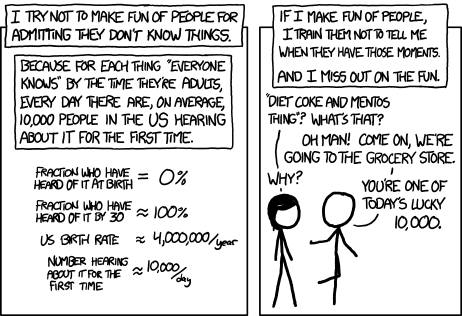
When stories capture enough attention or persist long enough, they tend to dictate cultural norms. These norms are things that everyone assumes to be true, often because they fit within our internal narratives.
Social norms marketing is a particular type of marketing tactic that attempts to change public behavior through the use of normative storytelling. It attempts to correct internal beliefs of populations to remove peer pressure that doesn’t actually exist. It was used in Montana to reduce how many people got behind the wheel of a car after drinking3. On college campuses, it can reduce the incidence of binge drinking4. Stereotypes are the antithesis of this as they often tell stories about groups of people that have absolutely no basis in fact. For example, women in STEM are often discriminated against simply because these stereotypes exist, even if individuals hold no perceived bias. Accomplishments by women in STEM are often discounted or attributed to outside help5 simply because that stereotype exists and is widely known.
Modern marketing often uses narratives to explain the value they offer to the world. Sometimes that value is utilitarian in nature, but more often the largest brands want to convince people that the things they offer are more than their intrinsic value. Apple sells a narrative around being a part of the creative lifestyle. Hermès connects class and luxury to durability. Nike inspires the first step towards greatness.
In the tech world, storytelling captures the investment of venture capitalists. At the earliest stages, they are attracted to individuals who can weave a narrative around future possibilities (especially large exits). Later on, many are looking for growth and solid reasons for why that growth will continue into the future. It also captures the time and talent of individuals looking to leave their mark on the world by joining these early stage companies. Programmers tell stories to themselves, each other, or rubber ducks6 about why complex systems are behaving in some observed way. This technique allows them to better understand the true nature of their system so they can expand upon it or fix some deficit.
In business, leaders are often taught to repeat their cultural values ad nauseam. This again is a powerful storytelling device that allows people to internalize the things that are most important to the business. These narratives give us terms, ideas, or phrases like “standing on the shoulders of giants7” that allow us to understand more with less deliberation and conscious thought.
They say that everyone has a book in them. I’d say that everyone has a story to be told. If you want to tell yours, reach out.
- This essay is a great example. ↩︎
- https://www.nature.com/articles/s41586-019-1806-y ↩︎
- (Drinking and Driving campaigns in Montana) Social norms media marketing can be effective at changing drinking-related behaviors at the population level. – https://www.ncbi.nlm.nih.gov/pmc/articles/PMC4942845/ ↩︎
- (Binge drinking on college campuses) We found that campaign readership was associated with more accurate perceptions of peer alcohol use, which, in turn, was associated with self-reported lower number of drinks per sitting and experiencing fewer blackouts. – https://www.ncbi.nlm.nih.gov/pmc/articles/PMC6092746/ ↩︎
- In addition, accomplishments that challenge the stereotype (e.g., women being good at science) are often discounted or attributed to outside help – https://www.nature.com/articles/s41599-020-00654-0 ↩︎
- https://en.wikipedia.org/wiki/Rubber_duck_debugging ↩︎
- https://en.wikipedia.org/wiki/Standing_on_the_shoulders_of_giants#:~:text=This%20concept%20has%20been%20dated,on%20the%20shoulders%20of%20giants.%22 ↩︎
Leave a Reply